Mint NFT standards shaped ownership and redeemable privileges through different contract interfaces
Mint NFT standards defined how contracts represented unique tokens, token quantities and product redemption privileges on Mint's former network. ERC-721 handled individual NFTs, ERC-1155 supported multiple token types and draft ERC-7765 added privilege management, while ERC-404 introduced experimental hybrid behavior. Mint ceased operations on April 17, 2026; the remaining withdrawal service does not list NFTs.
- updatedA token standard describes a contract interface, while the collection's implementation determines extra restrictions, metadata changes and application rules. Ownership transfers, privilege exercise and physical delivery are distinct operations, even when one application presents them together.
Bottom line: ERC-7765 extended ERC-721 with privilege records, while physical product delivery depended on a separate fulfillment process.
Identify the contract behavior behind an NFT
A Mint NFT's deployed contract determined its ownership and transfer interface; ERC-165 supplied supportsInterface for declaring supported interfaces. That declaration helped software select the right queries, while the implementation determined actual behavior. ERC-721 ownership used ownerOf; ERC-1155 balances used balanceOf with an account and token ID. A declared interface alone did not establish complete compliance, trustworthy administration or an active Mint network.
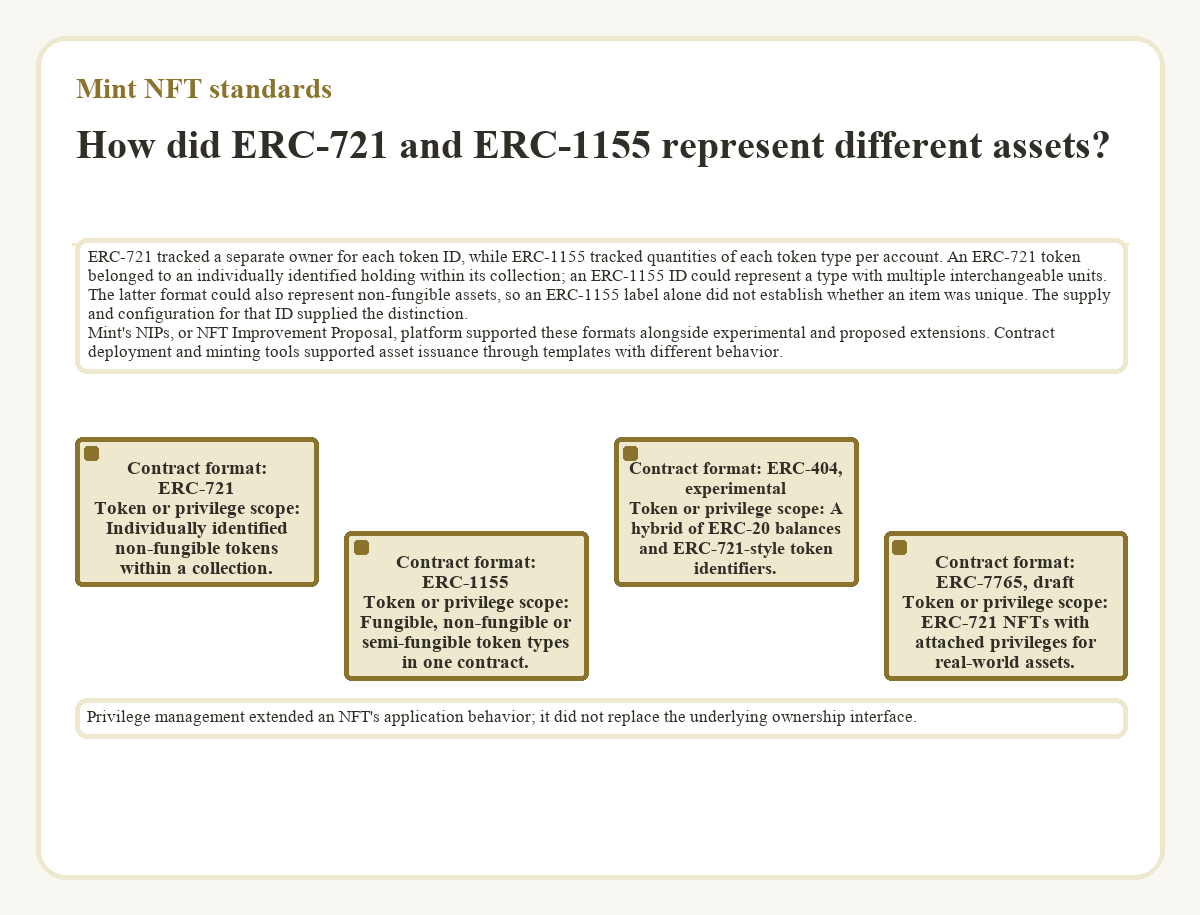
How did ERC-721 and ERC-1155 represent different assets?
ERC-721 tracked a separate owner for each token ID, while ERC-1155 tracked quantities of each token type per account. An ERC-721 token belonged to an individually identified holding within its collection; an ERC-1155 ID could represent a type with multiple interchangeable units. The latter format could also represent non-fungible assets, so an ERC-1155 label alone did not establish whether an item was unique. The supply and configuration for that ID supplied the distinction.
How did ERC-721 and ERC-1155 represent different assets?
ERC-721 tracked a separate owner for each token ID, while ERC-1155 tracked quantities of each token type per account. An ERC-721 token belonged to an individually identified holding within its collection; an ERC-1155 ID could represent a type with multiple interchangeable units. The latter format could also represent non-fungible assets, so an ERC-1155 label alone did not establish whether an item was unique. The supply and configuration for that ID supplied the distinction.
Mint's NIPs, or NFT Improvement Proposal, platform supported these formats alongside experimental and proposed extensions. Contract deployment and minting tools supported asset issuance through templates with different behavior.
- Contract format: ERC-721 Token or privilege scope: Individually identified non-fungible tokens within a collection.
- Contract format: ERC-1155 Token or privilege scope: Fungible, non-fungible or semi-fungible token types in one contract.
- Contract format: ERC-404, experimental Token or privilege scope: A hybrid of ERC-20 balances and ERC-721-style token identifiers.
- Contract format: ERC-7765, draft Token or privilege scope: ERC-721 NFTs with attached privileges for real-world assets.
Privilege management extended an NFT's application behavior; it did not replace the underlying ownership interface.
Mint's NIPs, or NFT Improvement Proposal, platform supported these formats alongside experimental and proposed extensions. Contract deployment and minting tools supported asset issuance through templates with different behavior.
| Contract format | Token or privilege scope |
|---|---|
| ERC-721 | Individually identified non-fungible tokens within a collection. |
| ERC-1155 | Fungible, non-fungible or semi-fungible token types in one contract. |
| ERC-404, experimental | A hybrid of ERC-20 balances and ERC-721-style token identifiers. |
| ERC-7765, draft | ERC-721 NFTs with attached privileges for real-world assets. |
Privilege management extended an NFT's application behavior; it did not replace the underlying ownership interface.
ERC-7765 privileges and redemption records
Mint introduced ERC-7765 in August 2024 to represent NFTs with exercisable privileges tied to real-world assets, including product redemption. The proposal remains a draft and separates token ownership from exercising a product benefit.
ERC-7765 inherits ERC-721 transfer and approval logic.
Its getPrivilegeIds function lists the privilege identifiers bound to an NFT. This relationship separates the token's identity from the benefits that an application attaches to it. A collection could expose several privileges without creating a separate NFT for each one.
The isExercisable query describes whether a privilege can be exercised for a beneficiary; isExercised reports whether it has been exercised for that beneficiary. Both include the token ID and privilege ID. A negative response for one beneficiary does not, by itself, establish that nobody has used the privilege. The implementation's state rules govern that interpretation.
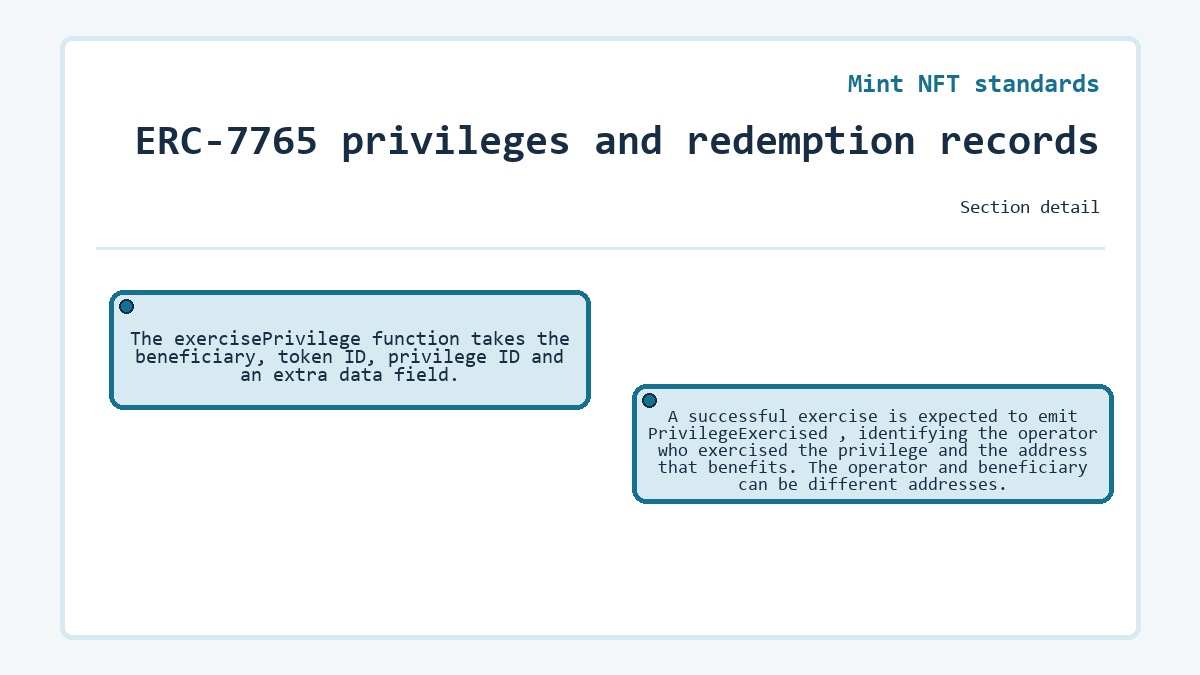
The exercisePrivilege function takes the beneficiary, token ID, privilege ID and an extra data field. A successful exercise is expected to emit PrivilegeExercised, identifying the operator who exercised the privilege and the address that benefits. The operator and beneficiary can be different addresses.
The draft does not impose a universal expiry period, reset policy or automatic NFT burn on redemption. Individual implementations determine those details, so a transfer can change ownership while previously exercised benefits remain subject to the collection's state rules.
Permission to transfer and permission to redeem
ERC-7765 separates the beneficiary of a privilege from the account that has permission to exercise it.
ERC-7765 leaves authorization for exercisePrivilege to the implementation.
A beneficiary address identifies who receives the benefit; that address alone does not establish who may initiate the action.
Mint's ERC-7765 example contract restricted privilege exercise to the NFT owner. It stored the beneficiary for each token-and-privilege pair and rejected a second exercise once that pair had a stored beneficiary. Its isExercisable query checked whether the pair remained unused, while isExercised checked whether the stored address matched the queried beneficiary. These were properties of that example contract, not universal access rules for every ERC-7765 implementation.
An ERC-721 transfer approval therefore did not grant redemption permission in that example. A marketplace could recognize inherited transfer functions without supporting privilege exercise, because transfer compatibility and benefit access required different application support.
ERC-404 version boundaries
ERC-404 combined fungible balances with NFT-style identifiers in an experimental design. Its original implementation could burn and mint NFTs as fractional transfers changed balances. The later v2.0-beta implementation introduced identifier banking and a path for transferring existing NFTs with full-token transfers. Mint's support for ERC-404 did not establish which version a particular collection used. Applying one version's transfer behavior to every historical Mint contract would therefore misdescribe its assets. ERC-721 and ERC-1155 had finalized specifications; ERC-404 supplied an experimental implementation.
Did an NFT standard keep its image or benefits available?
An NFT standard did not guarantee permanent media hosting, unchanging metadata or continued access to a Mint application.
The optional ERC-721 metadata extension exposed tokenURI, which identified metadata associated with a token. A URI is a uniform resource identifier; it can identify content that lives separately from ownership state.
ERC-721 permits mutable metadata URIs.
A change in an image or description did not, by itself, transfer the NFT. Conversely, an ownership record could remain meaningful when its associated media became unavailable. The contract's storage design and the availability of any separate hosting determined what remained accessible.
ERC-7765 inherits the ERC-721 NFT metadata interface and adds a separate optional privilege metadata extension through privilegeURI. The privilege schema describes a name, description and resource that explain the benefit separately from the NFT's own metadata.
Physical fulfillment depended on the product issuer's delivery arrangements. The PrivilegeExercised event recorded privilege exercise without establishing that a physical product reached its beneficiary.
NFT contract rules after Mint's shutdown
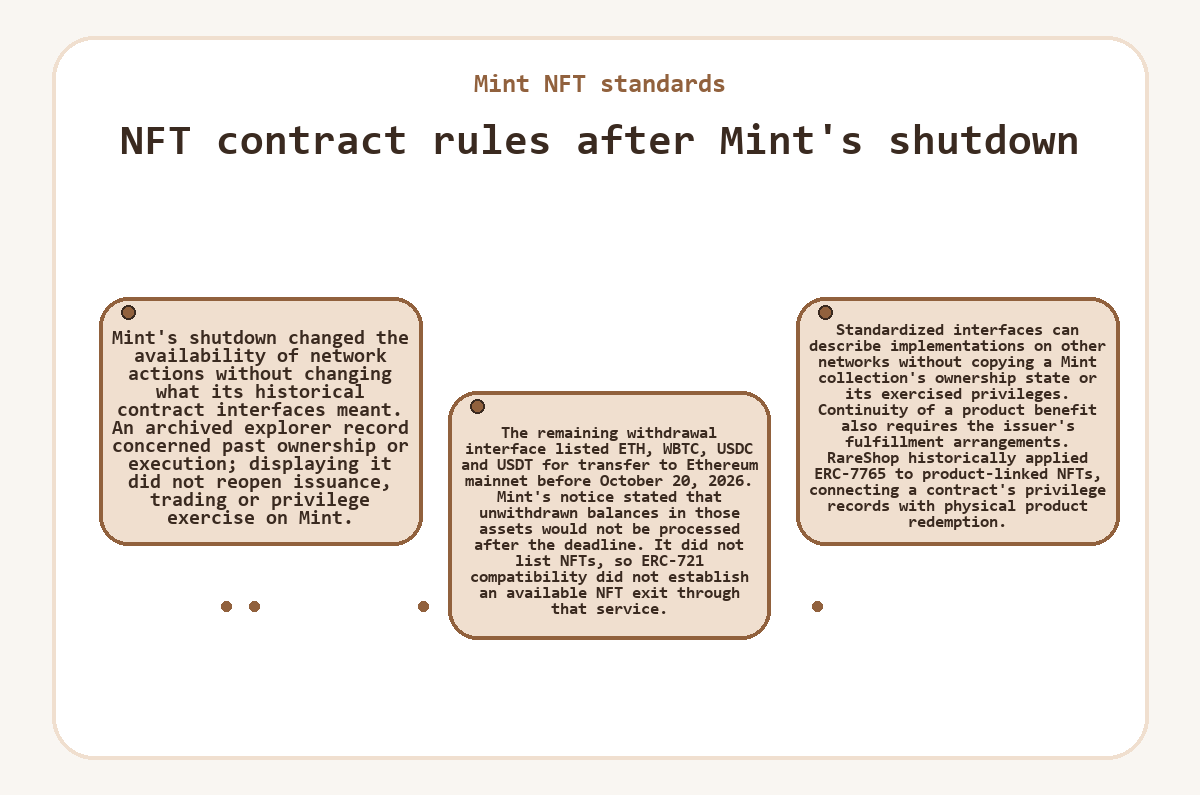
Mint's shutdown changed the availability of network actions without changing what its historical contract interfaces meant. An archived explorer record concerned past ownership or execution; displaying it did not reopen issuance, trading or privilege exercise on Mint. The remaining withdrawal interface listed ETH, WBTC, USDC and USDT for transfer to Ethereum mainnet before October 20, 2026. Mint's notice stated that unwithdrawn balances in those assets would not be processed after the deadline. It did not list NFTs, so ERC-721 compatibility did not establish an available NFT exit through that service.
Standardized interfaces can describe implementations on other networks without copying a Mint collection's ownership state or its exercised privileges. Continuity of a product benefit also requires the issuer's fulfillment arrangements. RareShop historically applied ERC-7765 to product-linked NFTs, connecting a contract's privilege records with physical product redemption.
Still wondering about Mint NFT standards?
Does ERC-721 require a function named mint?
ERC-721 does not prescribe a minting function or require the name mint. The standard defines ownership and transfer interfaces, while a collection supplies its own creation logic. A custom minting method can therefore coexist with ERC-721 compliance.
How are ERC-1155 metadata placeholders resolved?
The ERC-1155 {id} placeholder resolves to the token ID in lowercase hexadecimal, zero-padded to 64 characters without a 0x prefix. A client substitutes that value where the metadata format requires it. Using a decimal ID or leaving the placeholder unchanged can prevent a wallet from retrieving the intended metadata.
What does an invalid ERC-7765 privilege ID return?
ERC-7765 specifies that an invalid privilege ID causes exercisePrivilege, isExercisable and isExercised to throw. A false status response and a rejected query therefore express different conditions. An unavailable or failed query does not establish that a valid privilege is unused.
Will an ERC-1155 URI prove that a token type exists?
An ERC-1155 metadata URI does not establish that the token type exists. The optional uri function may return a valid string for an ID that has no existing token. Metadata discovery and supply or balance information answer different questions, so an image response alone cannot establish an issued holding.
Must ERC-7765 privilege IDs match NFT token IDs?
ERC-7765 uses token IDs and privilege IDs for different purposes. A token ID selects the NFT, while getPrivilegeIds returns the privilege identifiers bound to it. That binding establishes the relationship; matching numeric values do not prove that a privilege belongs to a token.
When does an ERC-1155 batch transfer reject mismatched inputs?
An ERC-1155 safeBatchTransferFrom call must revert when the token-ID and quantity arrays have different lengths. Each quantity belongs to the token ID at the matching array position. The call must also reject an amount exceeding the sender's balance for that token type, so batching does not relax balance requirements.
Can an ERC-721 safe transfer send a token to any contract?
An ERC-721 safe transfer requires a valid onERC721Received response when the recipient address contains contract code. A receiving contract that fails that check causes the transfer to revert. The ordinary transferFrom function does not require this receiver check, which can leave a token inaccessible in an incompatible contract.
Is a privilege beneficiary's address hidden in ERC-7765 events?
The PrivilegeExercised event includes the beneficiary's address in its indexed fields. It also identifies the operator and NFT token ID, with the privilege ID recorded in the event data. Address-level activity is visible in that record; the event interface does not require a shipping address or other delivery details.