Mint was an Ethereum Layer 2 for NFT creation and trading
Mint was an Ethereum Layer 2 network for creating and trading non-fungible tokens, or NFTs. Mint Studio was designed for NFT creation, while MintSwap offered token exchange and NFT trading. The network used Ethereum-compatible OP Stack infrastructure. General operations ended on April 17, 2026, leaving a withdrawal-only service for existing balances. That service lists ETH, WBTC, USDC and USDT for return to Ethereum mainnet before October 20, 2026. The currency withdrawal service does not list NFTs.
- updatedThe short version: Withdrawals run in weekly batches, so the October 20, 2026 deadline requires allowing time for settlement on Ethereum.
Media assets and NFT issuance
Text, images, audio and video were the inputs that Mint Studio was designed to turn into NFTs. Its creation scope included Mint, Berachain, Base, Optimism and BNB Chain. Smart contracts supplied ownership and transfer rules for the resulting tokens. The relationship between an asset, its token standard and its application determined what the token could represent.
The NIPs platform provided another creation path, with NFT contract deployment, issuance and related tools organized around supported token standards.
Ethereum execution and the supporting infrastructure
Ethereum compatibility shaped the network's development environment and connected it with familiar smart-contract tooling. The EVM, or Ethereum Virtual Machine, defined the execution model that its applications used. MintCore worked on the chain and its core components, while NFTScan Labs developed explorers and other infrastructure. Developers could work with Ethereum-style contracts, although each deployment still belonged to a distinct Layer 2 network with its own state.
The node software paired op-geth for execution with op-node for rollup coordination. Ethereum supplied the underlying data availability. The sequencer ordered transactions before the system published batches, linking local execution with the rollup's Ethereum-facing infrastructure.
Explorers and NFT data services made that activity easier to inspect and integrate into applications. Indexing reorganized contract events and ownership information for queries. An indexer did not replace the contract's execution rules, and retaining indexed history did not keep a retired network operational.
Trading tools and NFT applications
An NFT's trading options depended on the application that handled its market and settlement. MintSwap combined token exchange, NFT trading and NFT finance functions in the earlier ecosystem. Mint Liquid addressed multichain liquidity and asset interoperability in the broader design. A creation contract could issue a token without supplying a buyer or an available market. Listing, liquidity and settlement were additional parts of the trading relationship, each governed by the relevant application.
IP Layer addressed NFT registration, pricing and royalty-related uses. NFT-AI Agent was designed to combine NFT recognition, data retrieval, trading and market analysis.
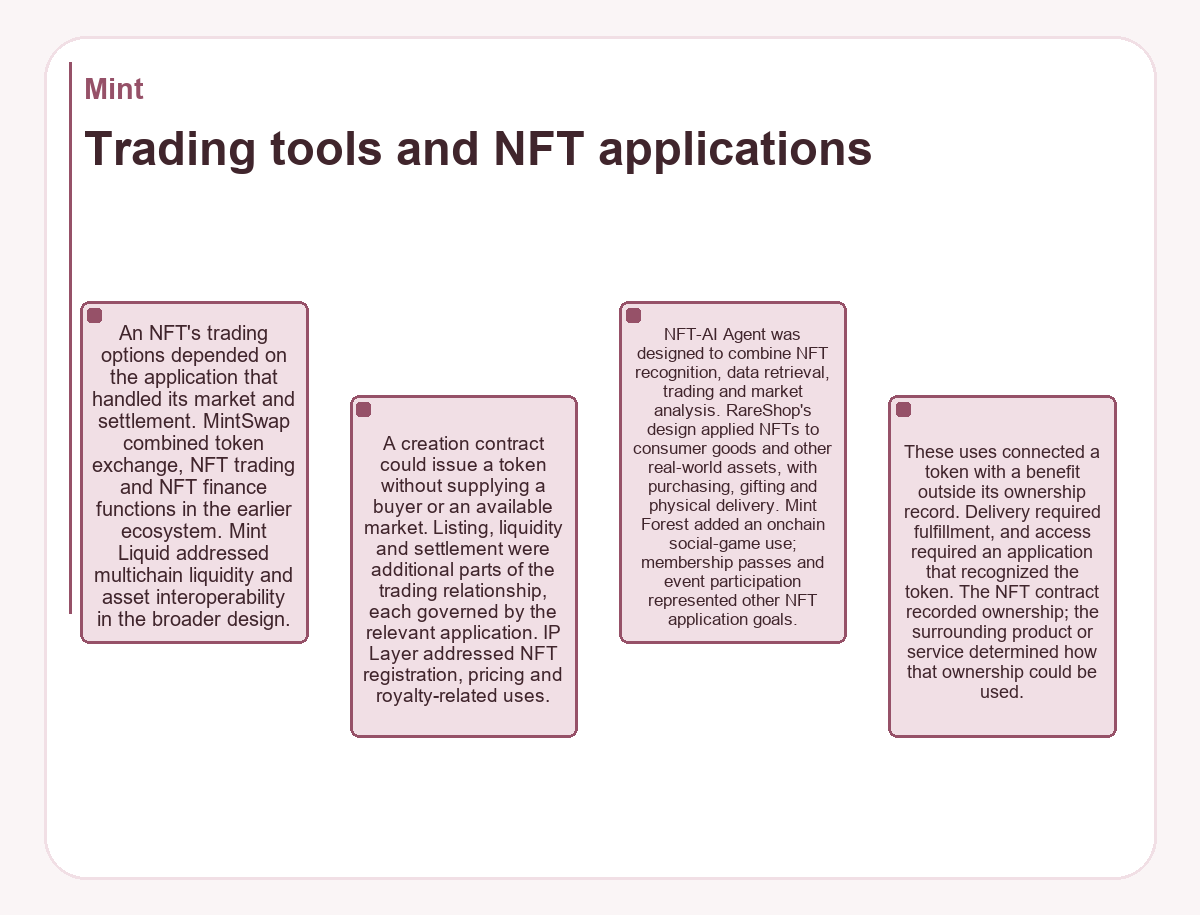
RareShop's design applied NFTs to consumer goods and other real-world assets, with purchasing, gifting and physical delivery. Mint Forest added an onchain social-game use; membership passes and event participation represented other NFT application goals. These uses connected a token with a benefit outside its ownership record. Delivery required fulfillment, and access required an application that recognized the token. The NFT contract recorded ownership; the surrounding product or service determined how that ownership could be used.
NFT standards and application-specific behavior
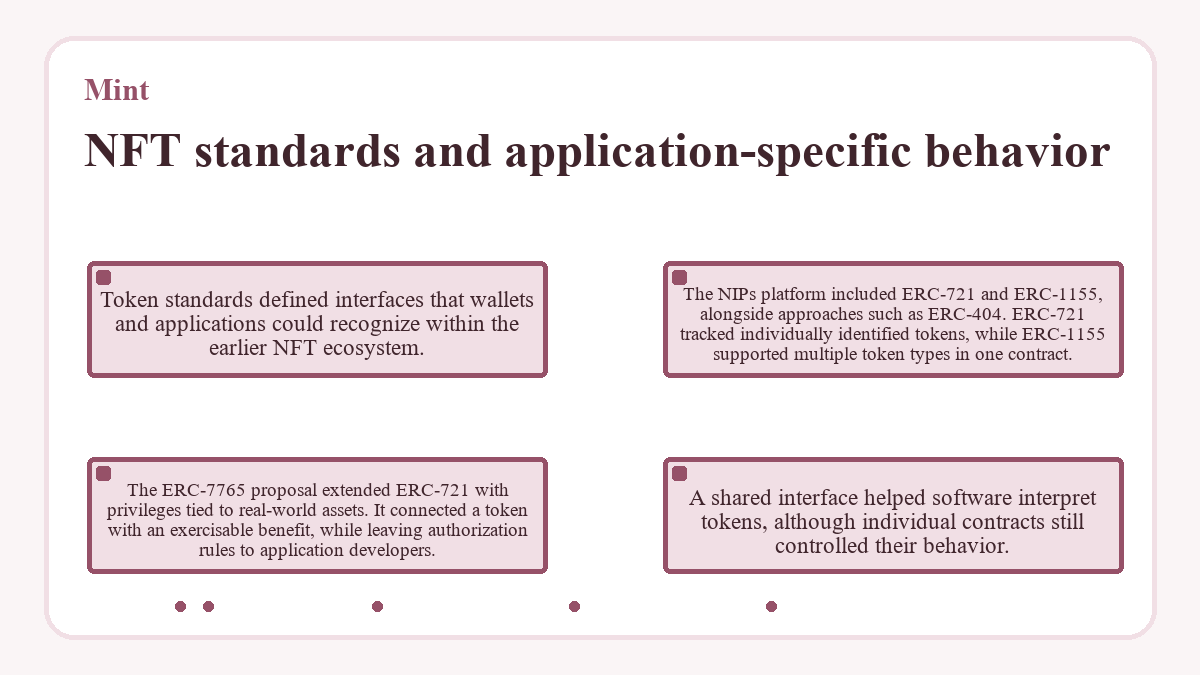
Token standards defined interfaces that wallets and applications could recognize within the earlier NFT ecosystem. The NIPs platform included ERC-721 and ERC-1155, alongside approaches such as ERC-404. ERC-721 tracked individually identified tokens, while ERC-1155 supported multiple token types in one contract. The ERC-7765 proposal extended ERC-721 with privileges tied to real-world assets. It connected a token with an exercisable benefit, while leaving authorization rules to application developers. A shared interface helped software interpret tokens, although individual contracts still controlled their behavior.
MINT, MintDAO and staking
MINT was the ecosystem's ERC-20 token, with a specified total supply of 1,000,000,000 tokens. Its intended roles included governance, developer incentives and asset pricing. MintDAO connected the token economy with treasury funding and ecosystem programs. ETH was the network's gas token; MINT belonged to the incentive and staking design. Holding the ecosystem token did not automatically represent a staked position or a claim on every associated service.
MintPool's staking design connected deposited MINT with sMINT staking certificates. The restaking design connected sMINT with BC721 Mint-eNFT assets and allocated a share of net sequencer revenue to eligible holders. These rewards depended on the underlying program and, for revenue sharing, on sequencer earnings.
Did lower gas fees determine an NFT's purchase price?
Lower gas fees reduced network transaction overhead; an NFT's sale price remained a separate market cost. Computation and Ethereum data-publication costs contributed to the rollup's fee model. Contract complexity, transaction data and the network's applicable fee settings affected an operation's cost. A creation transaction, a token transfer and a marketplace interaction could consume different resources.
Marketplace charges followed the venue's terms, and royalty arrangements depended on the applicable contracts and application rules. Returning funds to Ethereum was also a different operation from creating or trading an NFT. Historical gas comparisons could not supply a reliable quote for the retained withdrawal service.
Token history and media availability
An NFT ownership record identified a token within a particular contract and network. For ERC-721 tokens, the contract address and token ID distinguished the asset on that chain. The same token number in another contract identified a different NFT. Transfer history could show ownership changes, while metadata supplied a name, description or media pointer. These records had different purposes: identifying the token, tracking its transfers and describing the associated content.
Media availability depended on where the associated content was stored and whether that storage remained reachable. ERC-721 permitted mutable metadata pointers, so token persistence did not universally imply an unchanging image. Network retirement added another dependency: access to historical state through nodes, explorers or retained archives. Preserving contract details and available media could retain useful records, although it did not migrate the token to Ethereum or recreate a working market.
How long do the remaining asset withdrawals take?
The retained withdrawal service processes requests weekly and describes typical arrival on Ethereum within 10 days. The 10-day estimate is not a guaranteed maximum for every request. The withdrawal deadline for ETH, WBTC, USDC and USDT is October 20, 2026. Withdrawals must be completed before that date. The retained service will no longer process listed balances left afterward. Submission and receipt of funds are separate states, so waiting until the cutoff leaves little room for batch processing.
Decisions for existing holdings
Asset type determines the relevant action during the withdrawal window. A freely held balance in a listed currency matches the retained service. An NFT or staking certificate represents a different contract position, so its ownership record alone does not establish access to that same exit route.
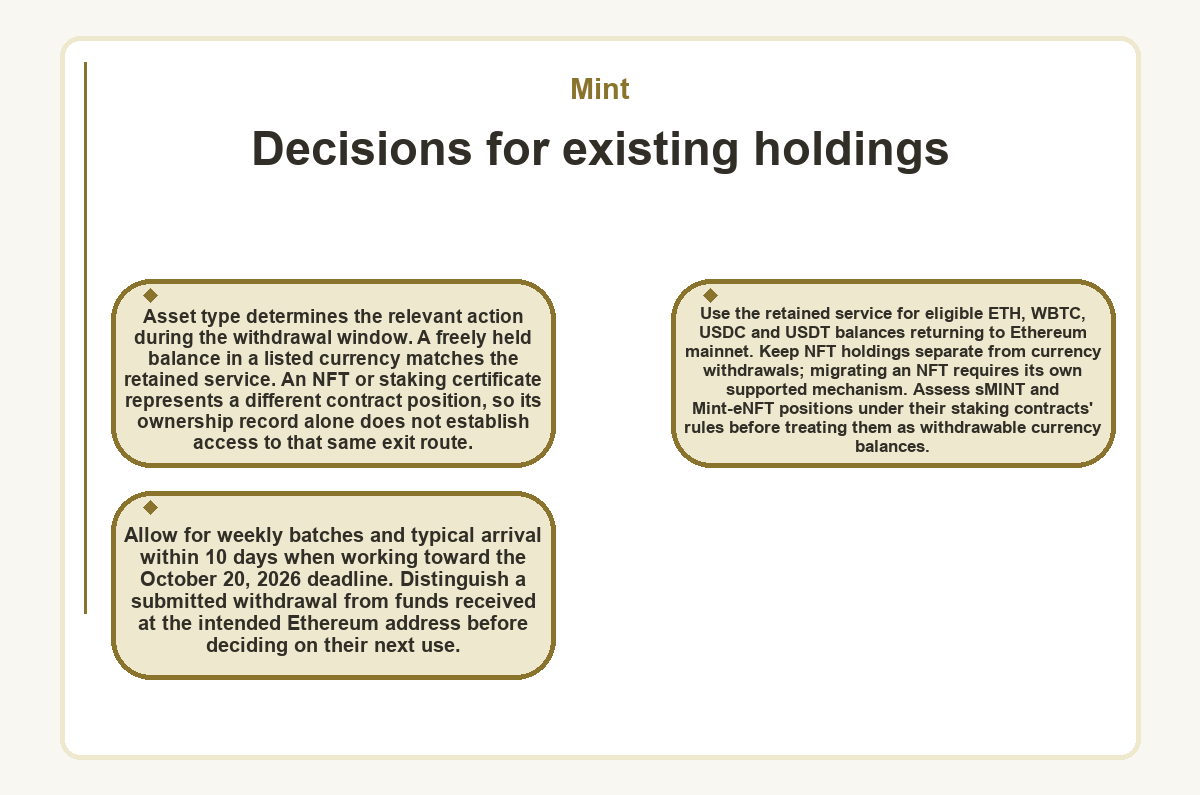
- Use the retained service for eligible ETH, WBTC, USDC and USDT balances returning to Ethereum mainnet.
- Keep NFT holdings separate from currency withdrawals; migrating an NFT requires its own supported mechanism.
- Assess sMINT and Mint-eNFT positions under their staking contracts' rules before treating them as withdrawable currency balances.
- Allow for weekly batches and typical arrival within 10 days when working toward the October 20, 2026 deadline.
- Distinguish a submitted withdrawal from funds received at the intended Ethereum address before deciding on their next use.
Mint: reader questions
Did adding Mint to a wallet automatically move assets from Ethereum?
Adding the network to a wallet changed its connection settings and did not transfer assets between chains. Mint mainnet used chain ID 185, which identified its network context. Moving value required a separate supported transfer mechanism. A familiar Ethereum-style address or a saved network entry did not make an Ethereum balance available on the retired Layer 2.
Is a wallet thumbnail proof that a Mint NFT collection is authentic?
A wallet thumbnail does not establish who issued an NFT or whether its collection is authentic. Unrelated contracts can reuse names, symbols and artwork. The chain, contract address and token ID identify the token. Authenticity also depends on the issuer's relationship with that specific contract; the displayed artwork does not prove that relationship.
How much of MINT's supply was allocated to MintDAO?
The original allocation reserved 50% of MINT's 1,000,000,000-token supply for MintDAO, equivalent to 500,000,000 tokens. That figure described the treasury allocation in the token model. It did not state the treasury's current balance, the circulating supply or an amount that individual holders could withdraw. Allocation and release into circulation were separate parts of the model.
Could an ERC-7765 privilege benefit someone other than the NFT holder?
The ERC-7765 interface allowed a privilege to benefit an address other than the NFT holder or transaction initiator. Application developers controlled who could exercise that privilege. Ownership, authorization and the designated beneficiary therefore had different roles. The interface supported that distinction without imposing the same redemption or access policy on every application.
When did Mint mainnet launch?
Mint mainnet launched in May 2024, after the project's development began in October 2023. NFTScan Labs and the MintCore developer team initiated the network. That launch belonged to its earlier operating period, which ended with the cessation of general operations on April 17, 2026.
Which NFTs did a collection-wide operator approval cover on Mint?
For an ERC-721 or ERC-1155 collection, operator approval covered the owner's tokens within that same contract. It did not authorize transfers from unrelated collection contracts or other networks. ERC-721 also allowed approval for an individual token. The permission's scope therefore depended on the approval type and contract, rather than the total contents of a wallet.